

What is ENHERTU used for?
ENHERTU is used to treat adults who have:
- HER2-positive breast cancer that has spread to other parts of the body (metastatic) or cannot be taken out by surgery and
- also received a prior treatment that targeted HER2-positive breast cancer.
ENHERTU is also used to treat adults who have:
- Hormone receptor (HR)-positive, HER2-low or HER2-ultralow breast cancer that cannot be removed by surgery or that has spread to other parts of the body (metastatic), and who have received at least one endocrine treatment for metastatic disease and are not considered suitable for endocrine therapy as the next line of treatment. A test will be performed to make sure ENHERTU is the right treatment.
- HER2-low breast cancer that cannot be removed by surgery or that has spread to other parts of the body (metastatic) and who have received prior chemotherapy for metastatic disease, or the disease has returned during or within 6 months of completing adjuvant chemotherapy (after surgery). If the breast cancer is also hormone receptor positive (HR+), patients should have received hormonal therapy. A test will be performed to make sure ENHERTU is the right treatment.
How does ENHERTU work?
ENHERTU contains the active substance trastuzumab deruxtecan, which is made up of a monoclonal antibody connected to a medicine intended to kill cancer cells.
The monoclonal antibody delivers the medicine to cancer cells that express HER2 proteins (known as HER2-positive).
Once ENHERTU enters the cell, the medicine becomes active and kills the cancer cells.

Please click the links above or the images below to download resources and view support materials.
Helpful Resources
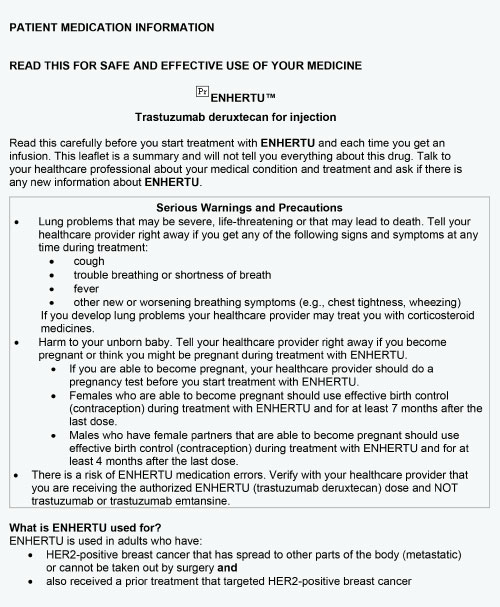
ENHERTU Starter Kit Materials
This kit has been designed to provide you with information and tools as you start ENHERTU. It includes tools to track appointments, help manage any side effects, track your symptoms and more. Please contact your oncology care support team to request a copy of the ENHERTU Starter Kit.
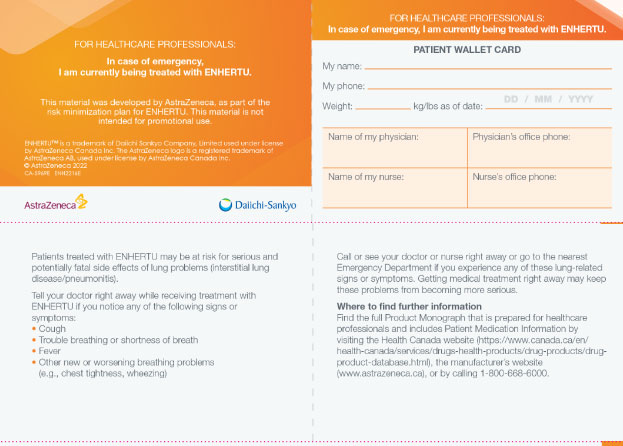
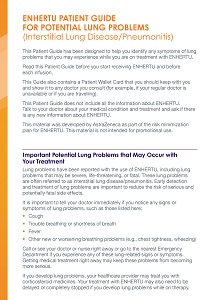
Safety Information for ENHERTU
Serious warnings and precautions with ENHERTU treatment
- Lung problems that may be severe, life-threatening or that may lead to death. Tell your healthcare provider right away if you get any of the following signs and symptoms at any time during treatment:
- cough
- trouble breathing or shortness of breath
- fever
- other new or worsening breathing symptoms (e.g., chest tightness, wheezing)
If you develop lung problems, your healthcare provider may treat you with corticosteroid medicines.
- Harm to your unborn baby. Tell your healthcare provider right away if you become pregnant or think you might be pregnant during treatment with ENHERTU.
- If you are able to become pregnant, your healthcare provider should do a pregnancy test before you start treatment with ENHERTU.
- Females who are able to become pregnant should use effective birth control (contraception) during treatment with ENHERTU and for at least 7 months after the last dose.
- Males who have female partners that are able to become pregnant should use effective birth control (contraception) during treatment with ENHERTU and for at least 4 months after the last dose.
- There is a risk of ENHERTU medication errors. Verify with your healthcare provider that you are receiving the authorized ENHERTU (trastuzumab deruxtecan) dose and NOT trastuzumab or trastuzumab emtansine.
Do not use ENHERTU if:
- You are allergic to trastuzumab deruxtecan or to any ingredients in ENHERTU. If you are not sure, talk to your healthcare professional before you are given ENHERTU.
To help avoid side effects and ensure proper use, talk to your healthcare professional before you take ENHERTU. Talk about any health conditions or problems you may have, including if you:
- have or have had any lung problems, any kidney problems, any heart problems, or any blood problems (low blood count).
Tell your doctor right away if you notice any of the following symptoms because some of them may be signs of a serious or possibly fatal condition.
Getting medical treatment right away may help keep these problems from becoming more serious.
- cough, shortness of breath, fever, or other new or worsening breathing problems. These may be symptoms of a serious and potentially fatal lung disease (interstitial lung disease/pneumonitis). History of this lung disease or kidney problems may increase the risk of developing interstitial lung disease. Your doctor may have to monitor your lungs while you are taking this medicine.
- chills, fever, sores in your mouth, stomach pain or pain when urinating. These may be symptoms of an infection caused by low levels of a type of white blood cell called neutrophils (neutropenia).
- new or worsening shortness of breath, cough, feeling tired, swelling of your ankles or legs, irregular heartbeat, sudden weight gain, dizziness, or loss of consciousness. These may be symptoms of a problem with your heart’s ability to pump blood (left ventricular dysfunction).
- chills or shaking, shortness of breath or wheezing, itching, rash or hives, flushing, dizziness, fever, feeling like passing out (infusion-related reaction).
You may experience the following side effects:
Very common side effects (may affect more than 1 in 10 people)
- Nausea
- Feeling tired (fatigue)
- Hair loss (alopecia)
- Vomiting
- Constipation
- Feeling less hungry (decreased appetite)
- Diarrhea
- Blood tests showing increased level of liver enzymes
such as transaminases
- Pain in muscles and bone
- Decrease in the number of white blood cells (leukopenia)
- Decrease in the number of red blood cells (anemia)
- Decrease in the number of platelets (thrombocytopenia)
- Stomach (abdominal) pain
- Infections of the upper respiratory tract
- Headache
- Coughing
- Sores in or around your mouth (stomatitis)
- Weight loss
- Fever (pyrexia)
- Low potassium in the blood (hypokalemia)
- Indigestion (dyspepsia)
- Numbness and tingling in hands and feet
Common side effects (may affect up to 1 in 10 people)
- Dizziness
- Rash
- Difficulty breathing (dyspnea)
- Bad taste in mouth (dysgeusia)
- Severe nosebleeds (epitaxis)
- Abnormal blood test (increase in blood alkaline phosphatase)
- Abnormal blood test (increase in blood bilirubin or blood creatinine)
- Dry eye
- Itching (pruritus)
- Darkening of the skin (skin hyperpigmentation)
- Blurry vision
- Excessive gas in the stomach or intestine, bloating (abdominal distension)
- Feeling thirsty, dry mouth (dehydration)
- Inflammation of the stomach (gastritis)
- Reactions related to the infusion of the medicine
- Infection of the lungs (pneumonia)
- Swollen hands, ankles, feet (edema)
These are not all the possible side effects you may feel when taking ENHERTU. If you experience any side effects not listed here, contact your healthcare professional.
For complete information on ENHERTU, you can talk to your doctor or healthcare team.
For further product/medical information or to report an adverse event, you may contact the Medical Information Department at:
Phone: 1-800-668-6000
E-mail: medinfo.canada@astrazeneca.com
Report Adverse Event:
https://contactazmedical.astrazeneca.com
Additional resources
-

Canadian Cancer Society
-

Canadian Breast Cancer Network
-

Rethink Breast Cancer
-

Quebec Breast Cancer Foundation
HER2=human epidermal growth factor receptor 2.





ENHERTU® and the Daiichi Sankyo logo are registered trademarks of Daiichi Sankyo Company, Limited, used under license by AstraZeneca Canada Inc.
The AstraZeneca logo is a registered trademark of AstraZeneca AB, used under license by AstraZeneca Canada Inc.
© AstraZeneca Canada Inc. 2026
CA-11888E
LEGAL NOTICE | PRIVACY POLICY | COOKIE POLICY | CONTACT US